By Bobak Kalhor, President, K2 Investment, Inc. — CA DRE #01198998 · Corporate DRE #01201662 — September 2026
A rent escalation is income growth you own. A renewal option is a decision that belongs to the tenant. Offering memoranda list them side by side under “lease terms,” which encourages buyers to add them together and call the total “term with growth.” They are closer to opposites.
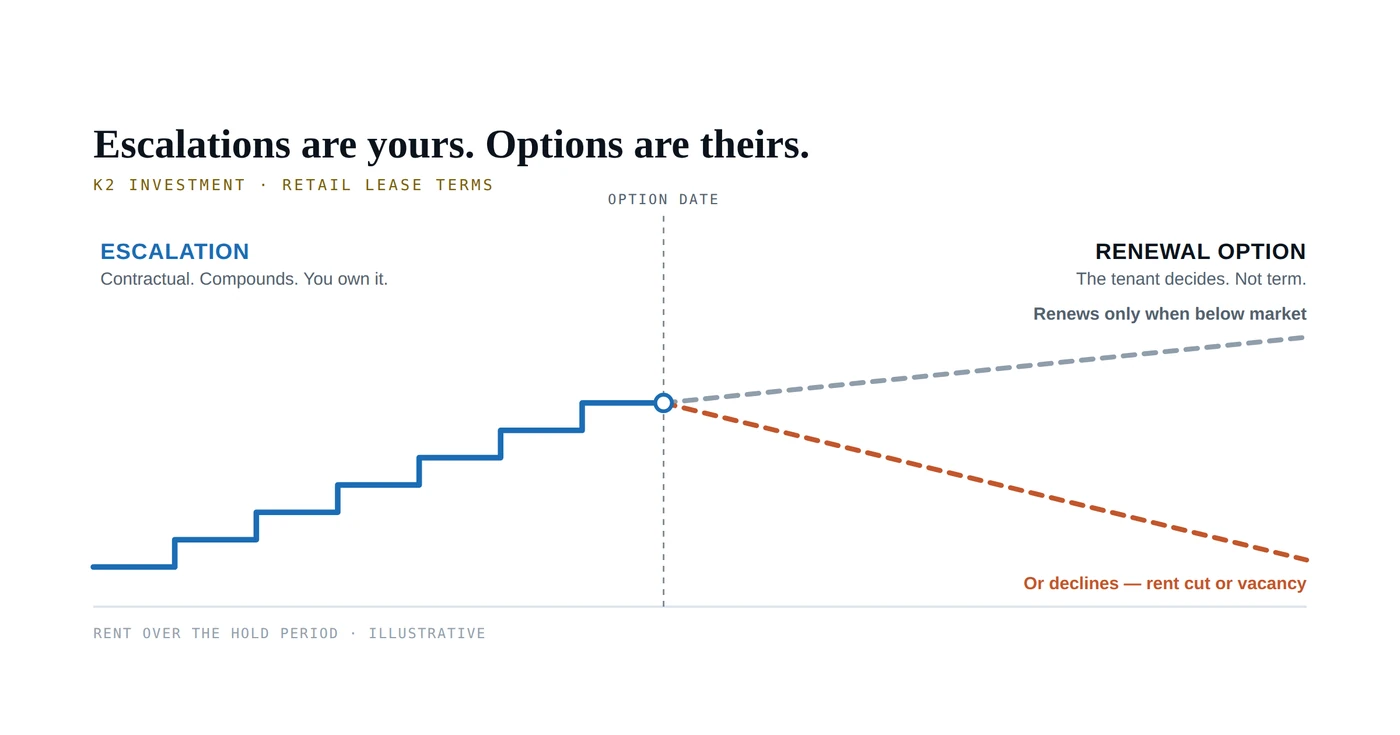
Of everything in a retail lease, these two provisions do the most to determine what you earn while you hold the property and what you get when you sell it. They are also the two most commonly skimmed. Here is how we read them.
What kind of escalation do you actually have?
Four structures show up, and the differences are not cosmetic.
- Fixed annual increases. Two or three percent every year. The cleanest structure for a landlord because it compounds without negotiation and without argument.
- Fixed step increases. Ten percent every fifth year is common in grocery. It sounds larger than an annual bump and delivers less. Ten percent every five years works out to roughly 1.9% a year.
- CPI adjustments. Tied to a published index, usually with a cap, sometimes with a floor. The details decide everything, and we cover them below.
- Percentage rent. Additional rent once the tenant's sales cross a breakpoint. Common in older retail leases, rare in modern grocery, and usually worth nothing.
And a fifth, which is not an escalation at all: flat rent for the entire term. It exists more often than buyers expect, particularly in leases signed in the early 2010s.
How much does the structure actually change the outcome?
Over a ten-year hold, more than almost any other single provision.
| Escalation structure | NOI in year 11 | Value at a 6.5% cap |
|---|---|---|
| Flat, no increases | $500,000 | $7,692,000 |
| 10% every five years | $605,000 | $9,308,000 |
| CPI, assumed 2.5% annually | $640,000 | $9,846,000 |
| 3% fixed annually | $672,000 | $10,338,000 |
Illustrative model only. Assumes $500,000 of starting net operating income, a constant 6.5% exit capitalization rate and no other changes. Does not describe any specific property or offering.
Same building, same tenant, same income on day one. The escalation clause alone accounts for roughly $2.6 million of difference between the top and bottom rows. That is why we read this clause before we read the cap rate.
What should you check in a CPI clause?
CPI language is where the real money hides, and five details do the work:
- Which index. CPI-U for a specific metropolitan area behaves differently from the national figure. Confirm the exact index named and that it is still published.
- The cap. A 3% cap means that in a high-inflation year your rent rises 3% while your insurance, taxes and maintenance rise by whatever they rise by. Landlords with capped CPI leases absorbed real losses during the 2021 through 2023 period.
- The floor. Without one, a flat or negative CPI year produces no increase at all.
- Cumulative or non-cumulative. A non-cumulative cap means the excess above the cap is gone permanently rather than carried forward. Over a long term this compounds badly.
- The measurement period. Annual, every third year, or at option only. Less frequent measurement with the same cap produces materially less rent.
Is percentage rent worth anything?
Usually not, and it is worth ten minutes to confirm rather than assume. Percentage rent is paid on sales above a breakpoint. A natural breakpoint is annual base rent divided by the percentage rate, so a tenant paying $200,000 of base rent under a 5% clause owes nothing until sales exceed $4,000,000.
Two things make it close to worthless in practice. Most clauses are set so the breakpoint is rarely reached, and many tenants, particularly grocery operators, have no obligation to report sales at all. If the lease does not require reporting, you cannot audit a breakpoint you cannot see. Treat percentage rent as zero in your underwriting and be pleasantly surprised.
Why is a renewal option not the same as term?
Because the option is the tenant's property, not yours. They exercise it or they do not, at their sole discretion, and you have no ability to compel or block that decision. A lease with four five-year options does not give you twenty years of income. It gives the tenant twenty years of choices.
The asymmetry is the part worth sitting with. A tenant exercises an option when the option rent is below what they would pay elsewhere, and declines when it is above. You only ever get the outcome that is worse for you.
| Market rent at the option date | What the tenant does | What you get |
|---|---|---|
| Higher than the option rent | Exercises immediately | Below-market rent, locked for another five years |
| About the same | Exercises or renegotiates | Roughly market |
| Lower than the option rent | Declines, then asks for a reduction | A rent cut, or a vacancy |
Illustrative. The pattern, not any specific lease.
Put plainly: every renewal option in your rent roll is a call option on your own building, written by a prior landlord, held by the tenant, at no cost to them. That is not a reason to avoid leases with options. Nearly every retail lease has them. It is a reason to stop counting them as term.
What is wrong with “fair market value at option”?
A fair market value reset sounds fair and rarely is, because of when the negotiation happens. By the option date the tenant knows precisely how dependent your income is on them, how much a vacancy in their space would cost you, and whether your loan matures soon. You are negotiating from the weaker side of the table with a countdown running.
Read the reset mechanism carefully. Some leases send a disagreement to appraisal or arbitration, which at least produces an answer. Others simply say the parties will agree, which is not a mechanism. And check whether the clause is one-directional: a reset to “fair market value” with no floor can produce a rent below what the tenant is paying today.
What should you ask for before you commit?
- The option notice deadline, as a date. Most leases require nine to twelve months' written notice. That date is when the uncertainty resolves, and it tells you where in your hold period the answer arrives. Check it against your loan maturity.
- What happens if notice is missed. Some leases void the option automatically. Others give the tenant a cure period after landlord reminder, which quietly converts a hard deadline into a soft one.
- Whether options survive assignment. An option personal to the original tenant and one that runs with the lease are different assets if that tenant sells its business.
- The full rent schedule through the last option. Not the summary. The schedule, with dates and dollar amounts, so you can model the exit rather than estimate it.
Then underwrite the term you are contractually owed, price the options as a probability rather than an asset, and let the escalation structure tell you what the property will be worth when you sell it.
Send us the lease abstract
If you are looking at a retail property anywhere in California and want a second read on the escalation and option language before you commit, send it over. We will tell you what we see, at no cost and with no obligation to work with us afterward.
Contact K2 Investment | (213) 624-0490 | bk@k2investments.com
Downtown Los Angeles is where we have spent the last thirty years, and it remains our proof rather than our perimeter. We represent buyers and sellers throughout California.
Related reading: How to Read a Shopping Center Rent Roll | Buying a Smart & Final or Sprouts | Five Ways a Retail Deal Dies in Escrow | Current K2 listings
Bobak Kalhor is President of K2 Investment, Inc., a boutique commercial real estate brokerage founded in 1995 and based at 530 E. 8th Street, Suite 400, Los Angeles, CA 90014. CA DRE #01198998 | Corporate DRE #01201662 | (213) 624-0490.
Published September 19, 2026. This article is general information from a licensed California real estate broker and is not tax, legal or investment advice. Illustrative models are labeled as such, use assumed inputs, and do not describe any specific property, offering or transaction. Verify all lease terms, income, expenses and tax consequences independently with your own counsel, CPA and qualified intermediary before acting.